Wednesday, October 11, 2017

Environmental Factors

               When one thinks of the common risk factors for developing heart disease, they think of age, gender, and many of the other risk factors stated above. However, environmental exposure plays a significant role in heart disease, both leading up to and while having heart disease. Both the heart and the vascular system are susceptible to many toxic agents found in the environment. These agents can include, but are not limited to, air pollution, arsenic, cadmium, and lead. Other things that pollute the air, such as smoking, play a key role in the development of heart disease as well. Exposure to agents such as these can “initiate” the start of the progression of heart disease or enhance the effects in those already diagnosed (Cesselman et. al, 2015). 


              Environmental factors do not just play a role in the development of heart disease. They are also significant in stroke and arterial disease as well. Metals, such as arsenic, that are found in polluted air have a detrimental effect on the blood vessels. Metals tend to damage the endothelial walls of the vessels. This, in turn, can cause scarring and may thicken the vessels, as seen in atherosclerosis. When vessels are thickened, less blood flow is occurring, which can lead to many problems including increased blood pressure and clogged vessels.
            In a study done by the American Heart Association, various factors were investigated in 2 groups. It was found that the incidence of heart disease was much higher in the urban and upper socioeconomic classes (Krishna, 1960). This can be, as stated above, due to the increased pollution of environmental air in urban areas.

              The body responses quickly to changes in the environment. For example, these changes include fluctuations in blood pressure. An increase in blood pressure significantly elevates a patient’s 

risk in developing heart disease by causes arteriosclerosis, or hardening of the arterial walls, and 

atherosclerosis, or plaque formation in the arterial walls. A consideration for patients who live in 

urban or heavily polluted areas would be to modify their hypertension factors, including 

medications, diet, exercise, and having a diet low in sodium and fats.
            
              Another environmental risk factor in developing heart disease is one’s diet. As stated before, there is a higher incidence of CAD in urban or low economic areas. In areas such as these, proper nutrition can be difficult to come across, especially in low economic communities. The population will be eating unhealthy meals that contain numerous saturated fats, carbohydrates, and excessive sodium. In combination with other risk factors, this can increase the fatty plaque formation in the arterial walls and cause occlusion, leading to higher incidences of heart disease. Diet is one of the number one modifiable risk factors, however, and should be taken into consideration in the populations stated above. Access to healthy meals, such as local food banks, would be an excellent resource for patients experiencing these difficulties.
            Exposure to secondhand smoke can be just as deadly to an individual as smoking the cigarette themselves. Smoking causes vasoconstriction in the body, which narrows the blood vessels. This decreases blood flow to the heart. Smoking also causes an increase in fatty plaque build-up. These two body mechanisms increase the risk for developing heart disease, as stated before. In areas of high pollution, it can be difficult to avoid exposure to secondhand smoke. Something that those at risk for heart disease can do would be to wear masks out in public. The mask can filter the air that the body is breathing and provide a more pure air to breathe. It is very important to note your family history of heart disease when choosing your location to live and work.
            It is important to be able to modify this risk to a patient’s best ability. If there is a strong like to heart disease in the family, a patient should consider living in a pollution-free environment or rural area. Although it can be inconvenient at times, it is better to slow or prevent the progression of a deadly disease than to stack risk factors on top of one another until the disease is no longer in control. 


Tuesday, October 10, 2017

Diet

It is important, at any age, to take care of yourself. Whether that comes from choosing the right foods or keeping a well-balanced life style, staying healthy is essential to living a long, happy life. The first thing to look at when going to the grocery store is not the picture on the product, but the label on the product. Look at the ingredients and decide if that is something that should go in someone’s body. Meal planning is a helpful option because it gives one the time to plan each meal and not have to rush to throw it together last minute. Getting all of the right nutrients is important as well. The earlier one starts thinking about these things, the less worry they will face in the future.

            According to the American Heart Association, all age groups should look out for saturated fats, trans fats, and sodium. Too much of these can increase your risk of having a heart attack. Also eat a lot of fruits, whole grains, vegetables, fiber and skipping some meals with meat in it (American Heart Association, 2017). There are so many different types of fruits and vegetables, that it is easy to find some that one likes. Also, now with everything revolving around the internet, there are millions of recipes that are accessible to everyone. Eating healthy does not have to be a hassle or chore. It is something that will be beneficial in the long run and will not take away from one’s daily life.


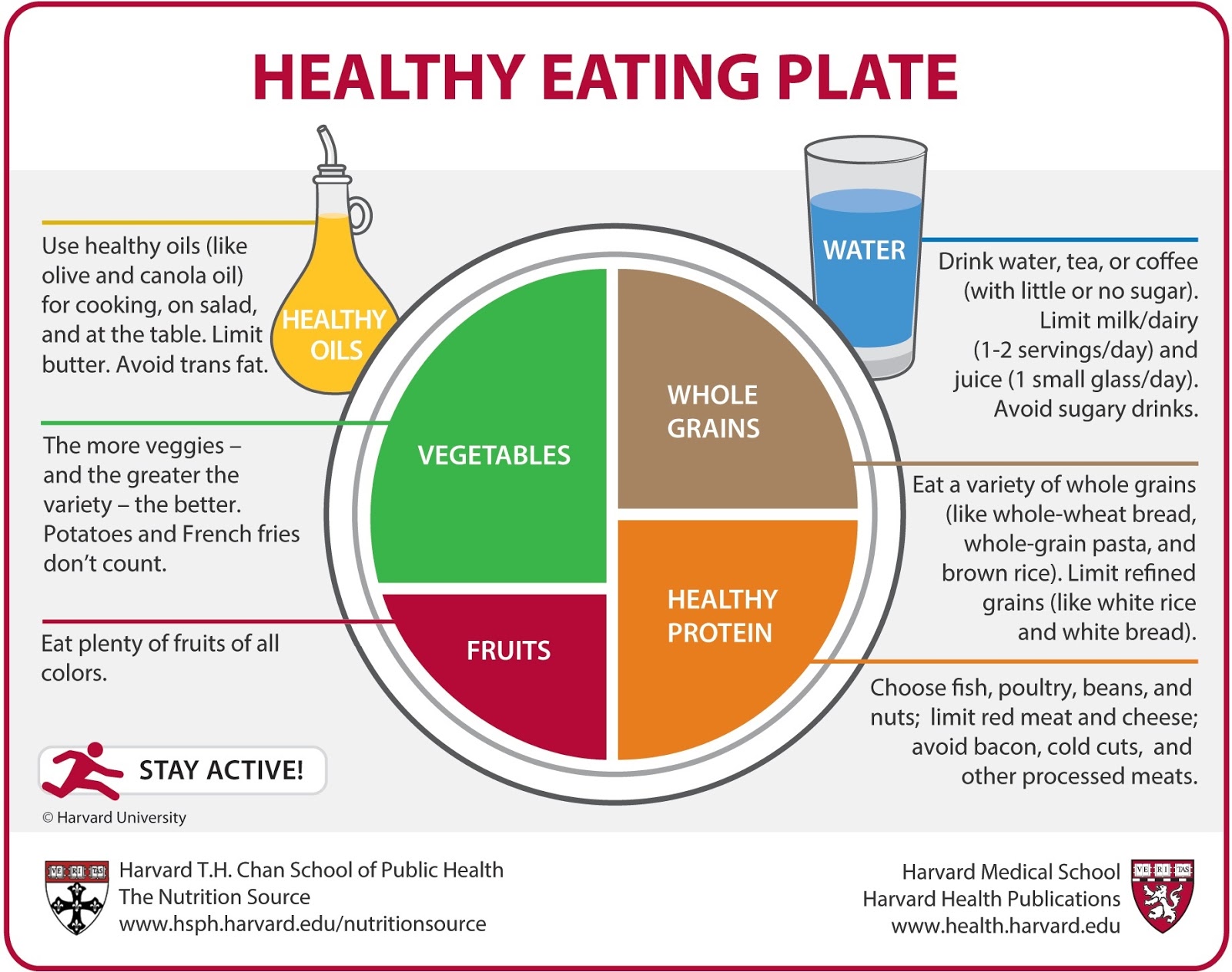
 This is a photo from Harvard Medical School that shows what one’s plate should look like and consist of. It is known that the more colorful one’s plate is, the healthier it is. Loading up on the vegetables and fruit can make a very vibrant dish that can be appeasing to one’s eye.
Another important factor is reading what is on the label. The first thing one should look at when picking up a food item is the serving size. Knowing the serving size will help figure out how much of each thing is in the product. Next, look at the total fat and make sure the serving size has an amount of fat that is less than 10 grams and the saturated fat is less than 3 grams (Department of Health and Aging, 2017). Also, the amount of sodium is important as well. Try to have less than 120 mg per serving, as anything more can be harmful (Department of Health and Aging, 2017). The next crucial thing to look at is what is in the ingredients. The key rule here is if one cannot pronounce it, then the ingredient should not go in one’s body. The first ingredient listed is the ingredient that has the greatest amount in the food. The first three ingredients are the ones that should be checked for trans-fat, saturated fat, and sodium (Department of Health and Aging, 2017).
            The last thing that is helpful in maintaining a healthy diet is meal planning. Now to some, this sounds dreadful and appears as a lot of work. All it takes is some planning and one day to put it all together. Once all the meals have been planned for the week, the week goes fast and eating healthy is not a lot of work. Everything will be laid out and ready to go, so all one has to do is grab it and go. Eating healthy does not have to be a lot of work. It can be simple and easy, if one is willing to do it.

Monday, October 9, 2017

Staying Fit

Lack of exercise can be detrimental to one’s health and staying active is easier than most people think. Going on walks daily is beneficial. Any type of physical activity can be helpful. “Physical activity can help you control your weight and reduces your chance of developing other conditions that may put a strain on your heart, such as high blood pressure, high cholesterol and diabetes,” (Mayo Clinic, 2016).
            It is better to start being active when one is younger. Regular exercise can slow down the aging process and give many benefits to the body (Gaz, 2016). Strength training and high intensity training can help maintain muscle mass, prevent cardiovascular decline and improve balance (Gaz, 2016). It is better to do these types of training when one is younger as these can be difficult to accomplish. If one starts younger, than it will be easier for them to keep exercising as they get older. One does not have to keep the same intensity throughout life. The body goes through stages and ages on its own and that is something we cannot control. Lowering the intensity as one ages is smart, as it still helps one’s health.
            For younger adults who want to aim for a high intensity workouts, they are easy to find on the internet. Some endurance training includes running and cycling for 30 minutes to an hour each day. It is important to also have some strength training in one’s routine, because as we age we lose muscle mass. One way to prevent that, or slow down the rate, is to start lifting weights (Gaz, 2016). Do multiple reps for each movement and try to increase the weight each week.
            Here is a video demonstrating some weight lifting movements for beginners. 
Just because one gets old, does not mean they are unable to stay active. If one can walk around, such as walking around the block each day or walking through the yard, it is a great way to stay active. If one is not able to walk that great anymore, there are still many exercises he or she can participate in. Here is a video showing some of the many exercises the elderly can do just by sitting on a chair.
As a reminder, one does not have to do high intensity workout to achieve benefits. Just taking the stairs, cleaning the house, gardening and walking the dog are great way to stay active and achieve the health benefits. If one was to do high intensity workouts, they would see results much faster, but sometimes that is not always an option.


Sunday, October 8, 2017

Treatments

There are many different treatments for heart disease based on the specific disease. No treatment will be the same for every person. Sometimes multiple treatment types are necessary. Some conditions may require surgical treatments such as a coronary stent in which a tube is placed in the arteries of the heart to keep open for proper blood flow. Another surgical procedure is known as an angioplasty which is a procedure that involves inflating a balloon inside an artery and sometimes using a stent to hold the artery open. A more invasive procedure may be necessary such as coronary bypass surgery. This is a surgery that restores blood flow to the heart by using a healthy artery or vein to bypass a blocked artery thereby restoring proper blood flow. Surgical repair of damaged valves may also be necessary.

In addition to surgical treatments, some conditions may also require medications to treat heart disease related conditions or conditions that lead to heart disease. Some of these medications include: Statins which decrease liver production of harmful cholesterol. Some examples of statins are Atorvastatin and Simvastatin. Blood thinners may also be used which help prevent clots from forming or dissolves existing clots. Some examples of blood thinners include Aspirin and Clopidogrel. Beta blockers are medications that will slow the heart rate and decreases blood pressure. Some examples of beta blockers include Atenolol and Metoprolol. There are also certain heart medications that reduce chest pain or pressure caused by blockages in the arteries. Some examples include Nitroglycerin and Isosorbide. Calcium channel blockers will relax blood vessels allowing blood to flow easier. One example of a calcium channel blocker is Amlodipine.

Self-Care treatments may be necessary in all cases in conjunction with the other treatments or as part of a plan to decrease the risk factors for heart related diseases. These treatments include physical exercise which studies have proven that aerobic activity of 20-30 minutes five days a week improves cardiovascular health. Weight loss can also improve cardiovascular health to reduce risks and complications related to obesity, high blood pressure, high cholesterol and diabetes. Following a low fat diet by reducing intake of high fat foods such as fried foods, high fat dairy (cheese and ice cream), and red meat. Some dietary requirements for health related diseases may also be following a low sodium diet. Following a low sodium diet helps to control high blood pressure and excess fluid. It may also make breathing easier if you have heart failure. The recommended daily allowance of sodium is less than 1500 milligrams of sodium each day. You can reach that goal by avoiding sauces, pickled items, canned foods, gravies and even sandwich meat. Choosing fresh fruits and vegetables is best and using natural flavor additives like lemon, garlic and herbs.

No treatment will be the same in every individual. Some treatments may require the use of all three treatments combined a surgical procedure with a medication regimen and suggested self care treatment plans.


Saturday, October 7, 2017

Frequently Asked Questions

Q: When should you go see a doctor?
A: One should go get an annual check-up every year. Sometimes, depending on one’s situation and condition, they should go more often than once a year. If one feels like something is wrong or is experiencing any of the symptoms listed above, they should go to a doctor immediately or as soon as possible.
Q: How many people have a heart related disease?
A: According to the Center for Disease Control and Prevention, there are 614,000 people who die of a heart related disease in the United States. That is 1 in every 4 Americans. It is also the leading cause of death in the United States for both men and women (CDC, 2017).
Q: What should you do to prevent getting one of these diseases?
A: Staying active and eating healthy are vital in reducing one’s risk of getting a heart-related disease. Watching what goes into one’s diet is important, as many unwanted fats and sodium can sneak into products. Buying fresh is always best. Also, exercising daily either by strength training or by just walking the dog, can help reduce the risk.
Q: Does genetics play a role?
A: According to the Center of Disease Control and Prevention, one’s risk of heart disease can go up if it runs in your family and is also based on your race, age, and ethnicity. It is said that genetics does play a role in factors that influence heart disease, such as high blood pressure, however, it could also be that the family is in the same environment (CDC, 2015).
Q: Do you have a higher risk of getting heart disease if you are obese?
A: Being overweight will increase your risk of getting heart disease, because high blood pressure and diabetes are associated with being overweight. Also, being overweight decreases HDL, “good” cholesterol. Changing one’s diet and exercise is necessary to reduce that risk of obtaining a heart-related disease.
Q: What is a stress test?

A: A stress test is taken when the patient is typically running on a treadmill and the electrical activity of the heart is monitored on an electrocardiogram (ECG or EKG). However, not everyone should get this test done because it does produce false positives. Only patients with a high risk of heart disease or have the symptoms should have this test performed.

Friday, October 6, 2017

References

  • About Heart Disease. (2015, August 10). Retrieved October 01, 2017, from                                                           https://www.cdc.gov/heartdisease/about.htm
  • Age-related Heart Disease. (2016, September 30). Retrieved from                                                                                           http://www.wakehealth.edu/Heart-and-Vascular/Conditions/Age-Related-Heart-                         Disease.htm
  • Classen, L., Henneman, L., Weijden, T.V., Marteau, T., & Timmermans, D. (2012). Being at risk                    for cardiovascular disease: Perceptions and preventative behavior in people with and                        without known genetic predisposition. Psychology, Health & Medicine, 17(5), 511-521.                 doi: 10.1080/13548506.2011.644246
  • Coronary Artery Disease Treatment. (2017, August 04). Retrieved September 30, 2017, from                       mayoclinic.org
  • Cosselman, K. E., Navas-Acien, A., & Kaufman, J.D. (2015, November). Environmental factors     in cardiovascular disease. Retrieved from                                                                                                                 https://www.ncbi.nlm.nih.gov/pubmed/26461967
  • Cox, O. (2017, April 30). Food labels: what to look for. Retrieved October 01, 2017, from                 https://www.eatforhealth.gov.au/eating-well/how-understand-food-labels/food-labels-                           what-look
  • D. (n.d.). Heart Disease Symptoms. Retrieved October 01, 2017, from     https://www.dreamstime.com/stock-illustration-heart-disease-symptoms-signs-coronary-            artery-cad-ischemic-ihd-also-known-as-atherosclerotic-image52190105#
  • D. (2012, August 13). Seated Exercises for Older Adults. Retrieved October 01, 2017, from                            https://www.youtube.com/watch?v=8BcPHWGQO44
  • Different heart diseases. (2017, May 29). Retrieved September 28, 2017, from                                                   https://www.world-heart-federation.org/resources/different-heart-diseases/
  • Family History and Heart Disease. (2015, July). Retrieved from                                                                                    http://www.heart.org/HEARTORG/Conditions/More/MyHeartandStrokeNews/Family-                History-and-Heart-Disease-Stroke_UCM_442849_Article.jsp#.WdWUzGhSw2w
  • Family History and Other Characteristics That Increase Risk for Heart Disease. (2015, August        10). Retrieved October 01, 2017, from                                                                                                                          https://www.cdc.gov/heartdisease/family_history.htm
  • Gaz, D. V. (2016, December 15). Stay fit at any age. Retrieved October 01, 2017, from                                      http://www.mayoclinic.org/healthy-lifestyle/fitness/in-depth/stay-fit-at-any-age/art-                 20270840
  • Healthy Eating Plate & Healthy Eating Pyramid. (2017, August 24). Retrieved October 01, 2017,    from https://www.hsph.harvard.edu/nutritionsource/healthy-eating-plate/
  • Heart Disease. (2017, August 24). Retrieved October 01, 2017, from                         https://www.cdc.gov/heartdisease/facts.htm
  • How the healthy heart works. (2017, January 09). Retrieved September 28, 2017 from                                    http://www.heart.org/HEARTORG/Conditions/CongenitalHeartDefects/AboutCongenital           HeartD                efects/How-the-Healthy-Heart-               Works_UCM_307016_Article.jsp#.WdELkMiGPIU
  • How to Help Prevent Heart Disease- At Any Age. (2017, April 3). Retrieved October 01, 2017,       from http://www.heart.org/HEARTORG/HealthyLiving/How-to-Help-Prevent-Heart-                Disease---At-Any-Age_UCM_442925_Article.jsp#.WdES28h942w
  • K. (2016, August 30). 17 Min Strength Training Workout for Beginners - Beginner Workout            Routine at Home for Women & Men. Retrieved October 01, 2017, from           https://www.youtube.com/watch?v=WIHy-ZnSndA
  • Maas, A., & Appelman, Y. (2010, December). Gender differences in coronary heart disease.        Retrieved from https://www.ncbi.nlm.nih.gov/pmc/articles/PMC3018605
  • Mathur, K.S. (1960, May 01). Environmental factors in coronary heart disease: An                                             epidemiologic study at Agra (India). Retrieved from                                                                                      http://circ.ahajournals.org/content/21/5/684
  • Resnick, A. (2014, March 01). How age and gender affect your heart. Retrieved from                                      https://wa.kaiserpermanente.org/healthAndWellness/?item=%2Fcommon%2Fconditions         %2FheartDisease%2FageAndGender.html
  • Strategies to prevent heart disease. (2016, June 17). Retrieved October 01, 2017, from                                  http://www.mayoclinic.org/diseases-conditions/heart-disease/in-depth/heart-disease-                             prevention/art-20046502
  • What do you want to know about heart disease. (2015, July 17). Retrieved October 01, 2017,                      from https://www.healthline.com/health/heart-disease